Katie Fogarty

“I want a divorce.”
Four words detonating a sunny day, shouted in my gravel driveway at my college boyfriend husband of twenty-four years. He looked shocked.
I felt crazy. How had I gotten to this moment, this mad utterance?
Together, we had traveled miles of good road since the night I perched on the sticky kitchen counter of his off-campus college apartment, legs locked around his waist, and declared, “I am in love with you.” He looked shocked then too.
No midlife marriage heads into a third decade undented and unscratched, but for years we moved in (mostly) happy synchronicity, buoyed through life’s ups and downs by a shared wiring toward optimism and the fact that we liked one another. Mix in a soft cushion of dot-com stock options and a semiofficial operating agreement that only one person was allowed to be crazy at a time, and we had a recipe that worked.
But suddenly, I felt crazy, most of the time.
I didn’t want a divorce—I wanted a good night’s sleep. And lots of them, strung together like a beaded necklace garlanding me with sanity, impulse control, and fewer racoon under-eye circles. I wanted to sleep like my husband, who hit the pillow and was snoring within seconds.
I craved an end to the pandemic: to the fear that choked me awake at 4 a.m., the relentless familial togetherness, the dystopian apartness from everyone else. I was exhausted on a cellular level—tired of Cloroxing the groceries, the WTF news cycle, an amoral president, the precarious finances of a household of a consultant and a start-up founder struggling with capital raising.
I was also sick and tired of sprouting hot tears at weird times and a spin cycle of outsized emotions, sick and tired of thinking—I need to get my shit together.
Much later, I would learn that the slow, subterranean gears of perimenopause were grinding away my serotonin and my dopamine, warping my coping skills, reshaping my sense of self. I would also learn I was far from alone.
As the pandemic ebbed, I found myself a newly minted midlife podcaster, host of A Certain Age, invited to midlife conferences and menopause company launch parties, listening to women share the same steady drumbeat—I thought I was crazy. I almost got divorced. Painful sex, loss of intimacy. Dry vagina, dry vagina, dry vagina.
I love a good cult, a sisterhood, a team. It was comforting to feel seen, but also infuriating. I navigated three pregnancies with What to Expect When You’re Expecting clutched in hand. Where the hell was What to Expect When Your Estrogen Is Exiting? I was blindsided by the magnitude of change.
Yes, I knew menopause was coming. Saturday-night teen babysitting gigs spent thumbing through other people’s Cosmopolitans taught me about sex and vibrators, offering a women’s health and sex ed barely hinted at by my Catholic high school. I knew from an early age that menopause would one day roll around with what sounded like pesky companions, hot flashes, and night sweats. Hot flashes have a very good PR agent—they are practically synonymous with menopause.
When my period disappeared at age forty-nine without a hot flash in sight, no sweaty, tangled bedsheets, I thought I was skating through.
Wrong.
Menopause’s other less showy, but equally maddening symptoms—interrupted sleep, fatigue, extreme mood swings, and more—were taking a star turn. I simply didn’t fully grasp that it was menopause that was wreaking havoc on my sleep, my mood, and, at times, what felt like my sanity. “We call that mood instability,” said my first podcast interview, my friend Anita, an ob-gyn who delivered JLo’s twins.
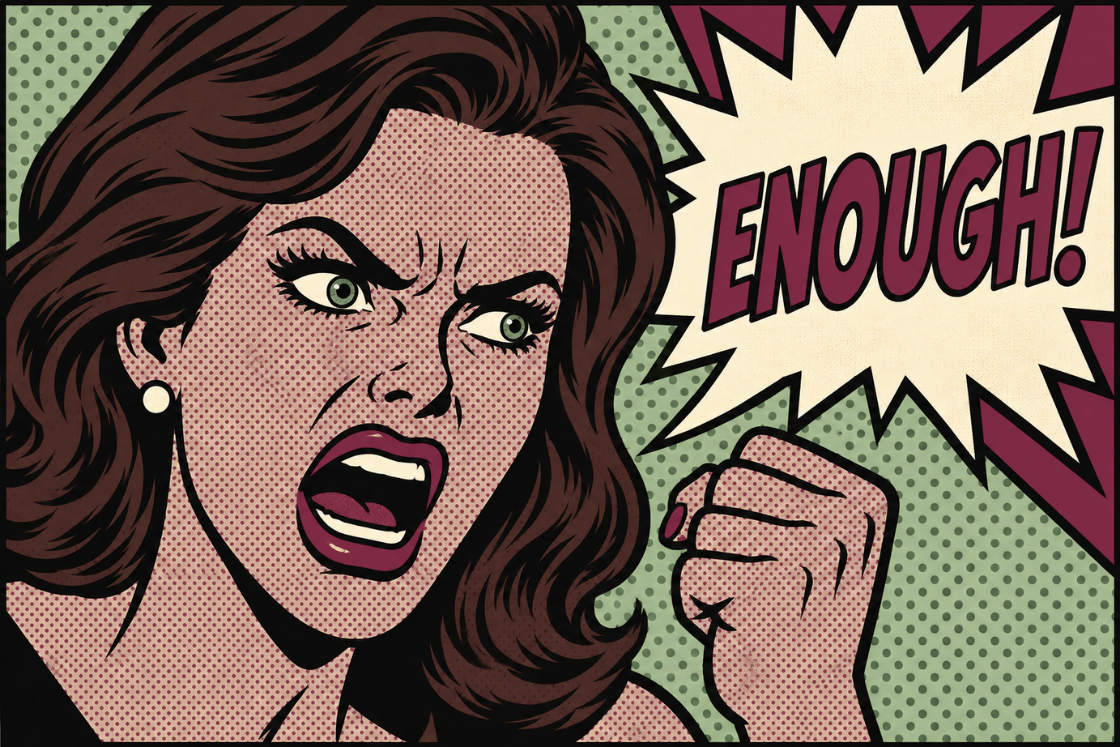
Mood instability sounds so genteel, like a tall glass of lemonade wobbling on the arm of a front porch rocking chair. My mood “instability” felt more like volcanic bouts of toxic fury—a California-grade forest fire laying cinematic waste to whatever’s in its path.
Maybe this is my hot flash? Where the hell is the flame retardant?
Much has been written about women’s anger and rage— journalist Rebecca Traister captures the transformative power of female anger as a force for collective social good in Good and Mad: The Revolutionary Power of Women’s Anger. In Rage Becomes Her, Soraya Chemaly argues that not only is women’s anger justified, but anger is an active solution for shaking off personal and cultural shackles. We can thank women’s anger for suffragette voting rights, the Montgomery bus boycott, and the rise of the gun control movement.
To be clear: My bouts of lava-hot fury did not feel like a force for good. It was scary to be the owner of an emotional regulation system that kept fritzing out, cycling somewhere between low warning sparks and full-on systems failure.
At one point during an early pandemic baking spree, as my husband and I had a top-decibel fight over baking soda, my teens shrank away to their bedrooms, and I retreated to my bed at 7 p.m. with a glass of wine, sharing the fight’s increasingly lunatic timeline with a text thread of high school girlfriends.
“I just want the pandemic to be over,” I cried through pixels. “And the baking soda to be kept in the right place, obvs.”
Our single friend Melissa typed back, “This is the first time since the pandemic started that I’m happy I’m sheltering in place alone.”
I need to get my shit together.
Slowly, my husband and I made some changes. We had honest, uncomfortable conversations and, as the world reopened, carved out time for short trips away as a couple. We took low-pressure dates walking our unruly pandemic puppy. He tabled the start-up and got a new job. We learned the life-changing magic of a great lube. I worked on less wine, better sleep—trading the panic-inducing evening news for bedtime reading with bluelight blocking glasses and a dropperful of CBD oil. Time passed, and I became more steady, solid.
One of my podcast guests, the social justice and menopause advocate Omisade Burney-Scott, calls menopause a “liminal experience”: a state of seismic transition—ambiguous, disorientating—that is both physical and emotional. But like any other portal (even a pandemic), the liminal space is ultimately traversed, and emergence occurs.
When I look back to that moment in the driveway just three or four years ago, it exists in both sepia-tinge and Kodachrome; a vivid snapshot of a slice of time that feels so utterly past, an artifact of history.
My husband and I are planting flowering containers and planning for an empty nest—Where shall we move? Maine, Portugal? And I am doubled over in silent shaking laughter as he helps me shoot an Instagram reel for my podcast in the produce aisle of a supermarket. How did I get here, holding an artichoke, convulsed with laughter at this madly delicious moment with the man I love?
Katie Fogarty is a podcaster, pro-age advocate, and host of the top-ranked podcast A Certain Age, a show that celebrates women 40, 50, 60+ who are aging out loud. She also hosts the literary podcast The Midlife Book Club.
A former journalist and PR executive, Katie also runs a career coaching company and sits on the boards of Let’s Talk Menopause and Flow Space and tries to talk her husband and three adult-ish kids into sweating it out at hot yoga with her.

Toxic Rage has been reposted with permission. The original essay can be found in Midlife Private Parts, a soulful and revealing collection of essays that explore the many facets of this transformative time in life. Each story sheds light, with humanity and good humor, on what it really feels like to move through the world as a midlife woman and beyond. To learn more about the book visit www.midlifeprivateparts.com.
If perimenopause has you feeling exhausted, irritable and unlike yourself, you’re not alone. Here’s why fatigue during perimenopause deserves a closer look.