Gretchen Terry-Leonard

Midlife, or middlescence, is another phase that provides us with opportunities to evolve and grow, and our bodies that seemingly haven’t changed in years start to signal that new chapters are ahead. Your sleep develops opinions, your internal thermostat runs on its own schedule at three in the morning, and when the hormone conversation begins, it tends to center on the ovaries. That’s fair; they’ve been running the show for decades. But they were never running it alone, and one of their most often overlooked partners lives in your gut.
Your gut influences how your body handles estrogen, and it responds to what you feed it and what you put it through. That makes it one of the places in the midlife experience where your everyday choices carry real weight. Here are two approaches to consider, one for your plate and one for your medicine cabinet.
You say biome, I say bolome
Your gut is a biome, a living place with its own residents and its own weather. It’s also a bolome. No, it’s not a Western tie worn by cowboys on date night. A bolome, which comes from metabolome, is about what gets done there: the chemistry, the transformations, the daily grind. Your gut, in its infinite wisdom, is both, and the part that recycles your estrogen is the estrobolome.
Estrogen deserves a more well-rounded reputation than the one it has. The ovaries get the headline in the reproductive years, but the work is shared with your adrenal glands, fat tissue, bone, brain, breast tissue, skin, and more.
Then comes midlife, throwing you for a loop. When the ovaries step back, they don’t take estrogen with them, they hand the job to the rest of the team.
Which brings us back to the estrobolome. Your liver packages used estrogen for disposal, and certain gut bacteria make an enzyme that opens the package up again, sending some of the estrogen back into circulation instead of out the door. It’s like metabolic regifting. In a study of more than two thousand adults, postmenopausal women had less of that enzyme activity than premenopausal women. Your gut isn’t manufacturing the hormone, and none of this replaces what you’ve worked out with your doctor. It means more than one system shapes how you feel and function, and this one likes to eat.
So how do you tend to your estrobolome? Nobody has identified an ideal gut composition for estrogen, and anyone selling you one is well ahead of the evidence. What the research does point to is that this function depends on a diverse, well-fed community, and that part is yours to influence.
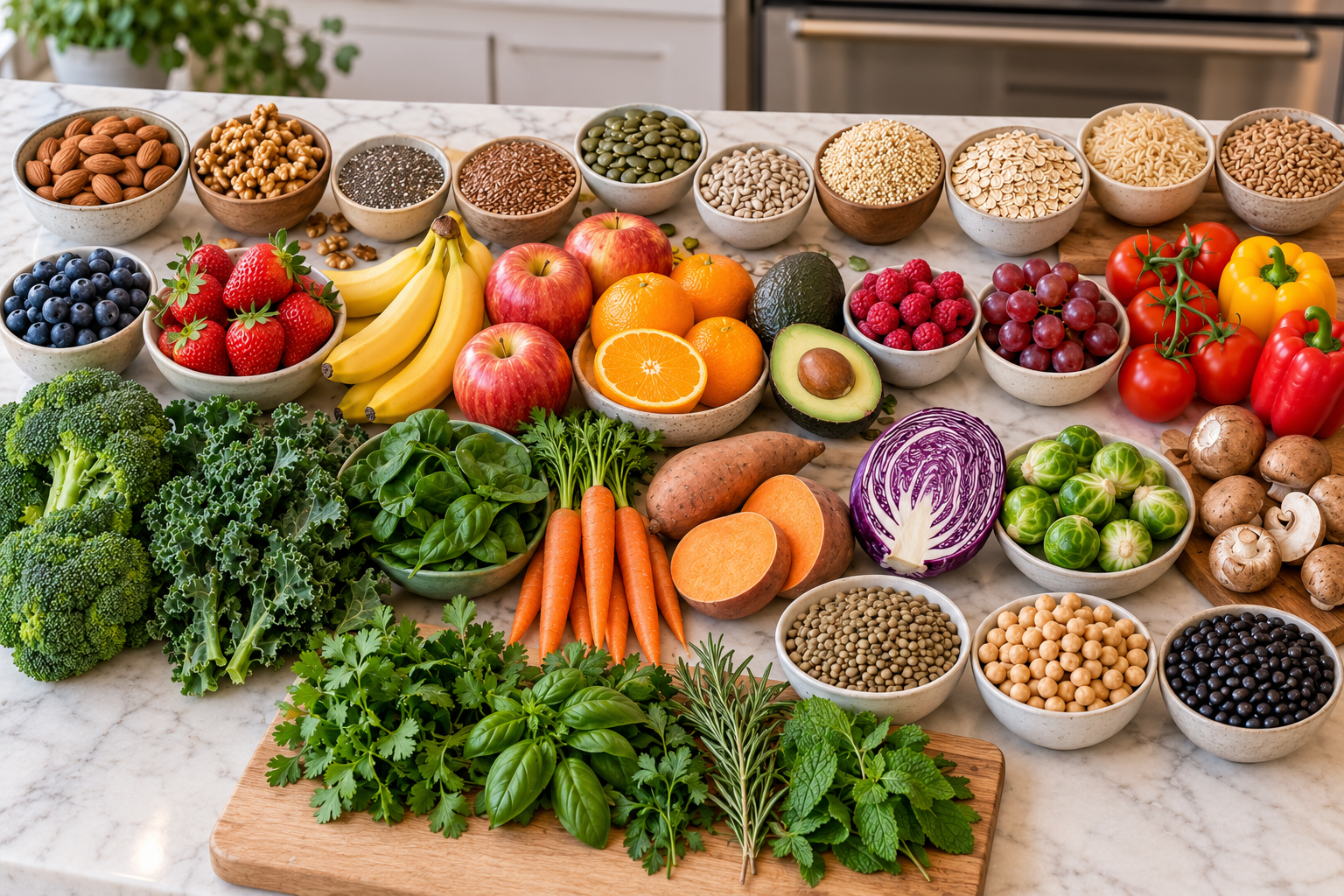
Aim for thirty different plant foods in a week, and before that sounds like a full-time job, look at what counts. Herbs and spices count. Nuts, seeds, beans, and whole grains count. The oregano you shook over the eggs counts, and so does the cinnamon in your coffee.
A bag of mixed nuts is three or four in one handful. Frozen mixed berries is another four. A three-bean chili is three before you’ve added the onion, the pepper and the tomato, and one pot of soup on a Sunday can carry eight or nine of your thirty through to Thursday.
It’s thirty across the week, not thirty a day, which works out to four or five a day. Most of us are closer than we think; we just weren’t counting the parsley.
Then there are the phytoestrogens, the plant compounds in soy, flaxseed and legumes. Your gut bacteria convert some of them into compounds with a stronger estrogen effect than the original food, and whether you can perform that conversion at all depends on which bacteria you happen to be carrying. It’s one reason soy does noticeably different things for different women.
Every quarter, put every bottle on the counter
You have two pharmacies. One is in your bathroom cabinet, and the other is your inner pharmacy, the trillions of microbes with a hand in nearly every facet of your health, from immunity to brain health to psychological well-being.
Among the most widely used drugs in the world, acid reducers and NSAIDs both leave a mark. In a study of more than eighteen hundred people, acid reducer users had measurably less microbial diversity, with roughly a fifth of their bacterial groups differing from non-users. Stomach acid is a gate, and when you lower the acid, you lower the gate. Bacteria from your mouth survive the trip and settle further along the pathway. NSAIDs work differently. Each tablet creates tiny tears in the gut lining, like taking sandpaper to silk, and more than half of people who take them regularly have small breaks in the small intestine without ever feeling it. Taken together, the two amplify each other, because the acid reducer shifts the bacteria in a direction that deepens the damage the NSAID started.
None of this is a reason to stop a medication you need. Plenty of people need these drugs and should stay on them, and what’s described here comes from chronic use, not from the ibuprofen you took after a long flight. If something is over the counter and you can do without it, do without it. If you need it, take it.
So, every quarter, or every six months at the outside, take the bottles out of the cabinet, line them up on the counter, and go through them with your doctor or your pharmacist. Ask which ones you still need, which ones you’re taking out of habit, and whether anything on that counter is working against the pharmacy you already have.
The daily opportunity
Midlife isn’t something that happens to your hormones while you stand by and watch, and your gut is one of the places you have an opportunity to tend to, at every meal and every trip to the medicine cabinet.
Aging should be an active process rather than a passive state; engaging in tiny ways to improve your gut will add up. Count the parsley, add the beans to the chili, and bring the bottles to your next appointment. The trillions of residents in your gut have been working on your behalf this whole time, and in your second prime, they’re well worth getting to know.
Gretchen Terry-Leonard works where longevity, transformation, and purpose meet. Her book, Your Second Prime: Does Aging Suck, or Do We Suck at Aging?, makes the case that we have many primes, and that a curious mind, asking better questions, shapes the years ahead. She co-founded the Center for Deeply Human Leadership, where her research on decision quality, leadership, and cognitive sovereignty keeps humans at the center of their own lives. A dietitian by training, she starts that work in the gut. She calls it your inner pharmacy.
Turns out, what we eat in midlife deserves a little more attention than we thought. For another perspective on food, hormones and feeling our best as we age, check out our sneak peek at Dr. Mindy Pelz’s Eat Like a Girl.