
At some point, many mothers of sons find themselves stepping into a role they never really planned for: mother-in-law.
It can feel a little strange at first. One day, your son is calling to ask how long to bake a chicken. The next, he’s asking someone else. Suddenly, there’s another important woman in his life, and you’re figuring out where you fit in.
The good news is that becoming a great mother-in-law doesn’t require perfection. You don’t need to bite your tongue until it bleeds, pretend to love every wedding decision, or act like you’re thrilled when your favorite holiday traditions get replaced by someone else’s. You just need a sense of humor, a little patience, and the ability to know when to offer advice—and when to keep it to yourself.
We discovered “How to Be the “Perfect” Mother-in-Law: A Lighthearted Guide for Moms of Married Sons,” by Lesley Koeppel, LCSW. The book is full of tips and advice to help set boundaries and navigate this potentially delicate role with as little family drama as possible.
In the excerpt below, you’ll find some fun and surprising facts about mothers-in-law, proving that this relationship has inspired stories, jokes, and eye rolls for generations.
So if you are about to become a new mother-in-law, or already hold that role and are looking for advice, pour yourself a glass of wine, take a deep breath, and get ready to become the kind of mother-in-law everyone is genuinely happy to see walk through the door.
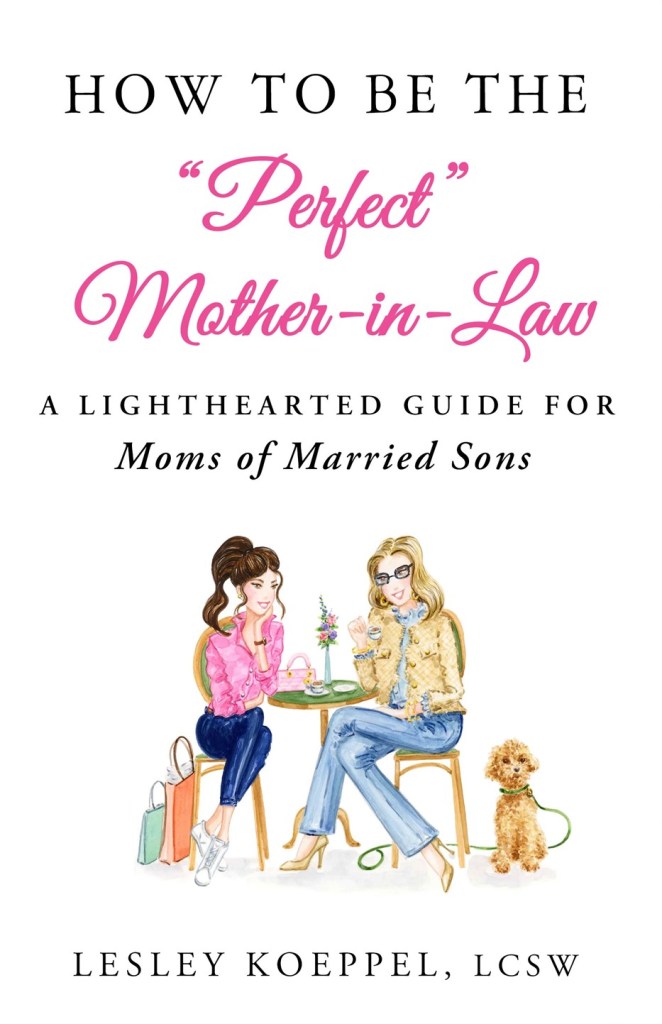
Excerpt from: “How to Be the “Perfect” Mother-in-Law: A Lighthearted Guide for Moms of Married Sons,” by Lesley Koeppel, LCSW. Reprinted with permission.
Chapter 12, Finding Humor in the Journey, takes a witty and refreshing look at one of the most emotionally charged family relationships: the mother-in-law-daughter-in-law dynamic. Through surprising historical facts, cultural traditions, relatable family tensions, and laugh-out-loud observations about everything from “The Tupperware Cold War” to “Mother-in-Law Suites,” this book, and particularly this chapter, shows that humor can be one of the healthiest tools for navigating complicated relationships.
Blending warmth, insight, and self-aware humor, this chapter encourages readers to laugh at themselves, recognize the universality of these dynamics, and let go of the pressure to be the “perfect” mother-in-law. It is just one example of the honesty, heart, and humor woven throughout How to Be the “Perfect” Mother-in-Law: A Lighthearted Guide for Moms of Married Sons, a book that offers readers both meaningful reflection and plenty of moments where they will think, “Oh my God, that is so true.”
1. Pentheraphobia:
Did you know there’s an actual term for the fear of one’s Mother-in-Law? It’s called entheraphobia! While most of us don’t suffer from a clinical phobia, it’s not uncommon to feel a touch of anxiety when navigating the complexities of this unique relationship.
2. Mother-in-Law’s Tongue:
There’s a plant known as “Mother-in-Law’s Tongue” (Sansevieria trifasciata), named—perhaps unfairly—for its sharp, pointed leaves. When bruised, it gives off a skunky odor, and if ingested, it can paralyze the mouth and lips, rendering speech nearly impossible. It’s a cheeky botanical metaphor for those moments when silence might truly be golden.
3. Mother-in-Law Suites:
Ever heard of a “Mother-in-Law suite”? It’s a separate living area in or near a family home, designed to allow in-laws to live close by—but not too close. The name itself has inspired countless jokes about privacy, soundproofing, and emergency exits, reflecting the delicate balance many families strive for.
4. The Original “Monster-in-Law” Goes Way Back:
The tension between MILs and their sons’ wives is nothing new—it even shows up in ancient texts and folklore. In many cultures, the MIL/DIL relationship is portrayed as one of the most emotionally charged. For example, in traditional Korean folktales, the Mother-in-Law is often depicted as demanding and critical, while the DIL strives to earn her approval. This dynamic has been so universal that it even inspired a Hollywood movie—Monster-in-Law—starring Jane Fonda as a Mother-in-Law who literally goes to war with her future DIL. Turns out, this age-old tension has long been considered ripe for drama—and comedy.
5. The Chicken Test:
In some Eastern European traditions, when a bride joined her husband’s family, her new Mother-in-Law would test her domestic skills—sometimes by handing her a live chicken and telling her to prepare it for dinner. The test wasn’t really about the chicken; it was about obedience, humility, and whether the new wife “respected” the matriarch’s authority. Imagine evaluating your DIL not just on her relationship skills, but on her poultry-handling technique! Thankfully, most modern in-laws skip the livestock and opt for slightly more civilized evaluations—like how your DIL loads the dishwasher!
6. The Tupperware Cold War:
There’s an unspoken power struggle in many households involving Tupperware. A MIL gives her DIL and son leftovers, in her old and very used Tupperware, from a family meal she has cooked. But secretly, the MIL monitors whether it’s returned (and how quickly). A DIL may not return it for weeks, may return it without it being perfectly washed, or not return it at all. It’s not about plastic, it’s about principle.
7. The Mother-in-Law Tree
There’s a massive tree in the Philippines known as the Mother-in-Law Tree (locally, Balete Tree), infamous in folklore for being haunted or harboring spirits. Why the name? Perhaps because it’s considered a little spooky, a little intimidating, and impossible to ignore—much like the stereotype of a formidable MIL. It’s said that travelers avoid sleeping near it… a sentiment some DILs may find oddly relatable during holiday visits.
8. Inheritance Laws in Ancient Rome
In Ancient Rome, mothers-in-law had legal authority over certain family matters—especially inheritance and dowries. If a husband died, the Mother-in-Law might step in to claim part of her daughter’s dowry or manage the household finances. It created enough tension that Roman playwrights frequently poked fun at overbearing MILs meddling in their children’s marriages. Think of it as early sitcom material— toga-style.
9. Royal MIL Drama Is Historical
Historical Mother-in-Law drama isn’t just common, it’s royal. Queen Victoria famously loathed several of her daughters-in-law, especially Princess Alexandra, whom she considered too flirtatious and extravagant. In letters, she called her “silly” and “frivolous”—but never to her face. Even in the royal courts, the art of the passive-aggressive MIL was alive and well.
10. Wedding Superstitions Around MILs
In some parts of Eastern Europe, it was once considered bad luck for a bride to look her future Mother-in-Law in the eye during the wedding ceremony—it was believed to provoke conflict in the marriage. The solution? Brides were advised to drop their gaze and avoid any prolonged contact. Superstition or survival strategy? You decide.
11. “Mother-in-Law Day” Is a Real Holiday
There’s an actual U.S. holiday called National Mother-in-Law Day, celebrated on the fourth Sunday in October. It was created in 1934 by a newspaper editor in Amarillo, Texas, who felt that mothers-in-law deserved their own version of Mother’s Day. The holiday never quite caught on nationwide, possibly because no one could agree on whether to celebrate it sincerely or sarcastically.
12. The Mother-in-Law Chair
In 18th- and 19th-century England, there was an actual piece of furniture called a “Mother-in-Law chair.” It was a narrow, upright, and deliberately uncomfortable wooden chair placed in the parlor—ostensibly for short visits. The joke? It was said to discourage long stays.
13. Freud Blamed the MIL
Sigmund Freud, the father of psychoanalysis, once blamed MILs for ruining marriages. In his writings, he claimed the MIL often becomes “the most dangerous rival” in a young couple’s home, especially if she’s competing for her child’s affection. He considered this a “normal” source of tension—not a pathology. But what’s funny is that Freud’s own mother was controlling and over-involved—and lived with Sigmund and his wife Martha for years. So maybe Freud’s theories were less theoretical and more… biographical.
The takeaway here is to keep your sense of humor through it all and remember that just because the potential for MIL/DIL issues has been around for centuries, it doesn’t mean that you have to repeat this pattern.
Lesley Koeppel, LCSW, is a psychotherapist with more than 30 years of experience helping individuals and families navigate serious health challenges and the most complicated relationships in life. In her New York City private practice, she has counseled countless women who, alongside personal struggles, often reveal the unspoken tensions between mothers-in-law and daughters-in-law. As a therapist and mother-in-law herself, Lesley brings compassion, humor, a direct approach, and clarity to a subject routinely joked about but rarely explored honestly in her debut book.