By Áine Rock

The marriage didn’t end just because I was unhappy. It ended because I finally stopped lying about it. That’s a different story.
I was standing at the kitchen sink washing strawberries when he looked up and asked, “Are we ever going to have sex again?”
Just like that. Between emails and sips of coffee.
Normally, I would have deflected. Changed the subject, made it light, made it fine. I had been making it fine for years. But something in me had shifted, and instead I turned from the sink, hands still wet, and said: “I don’t want to do this anymore.”
Not just the sex. The performance of fine. The whole careful, managed, slowly airless version of my life.
Those were the first true words I’d said in longer than I could account for. And they were the catalyst for everything that followed.
The lie that looks like love
I wasn’t faking orgasms. But my omissions were just as costly. I was unconsciously holding together the parts of a life that worked for everyone else. The stability for the kids. The not-disappointing-anyone. I didn’t even know I was doing it until I couldn’t do it anymore.
I wasn’t interested in sex as something to check off, a response to his need. So I avoided it. I just tucked desire away — next to the yearning for a different city, a creative life, a version of myself I hadn’t fully let go of yet — and got on with building the structure everyone else needed me to build.
I sat next to a woman on a plane once who told me, still visibly shaken, that her best friend had just admitted to faking orgasms with her husband for twenty years. Twenty years. I’ve thought about that woman a lot. Not with judgment — with recognition. Because that’s not a story about sex. That’s a story about a woman who ran the numbers and decided her own experience was the acceptable loss.
She faked it for twenty years. I disappeared for about the same.
She lied to him. I lied to myself.
The loss was the same.
Most of us learned to do this. We were taught early that our emotions, our desires, our uncertainties were too much — for the room, for the relationship, for the life we were trying to hold together. So, we stopped arguing for them. We contained ourselves. And after a while we stopped noticing we’d done it at all.
The bedroom and the rest of life are running on the same channel
Here’s what I know now, after the divorce and the move and the book and all the women I’ve sat with in my work as a somatic practitioner: the woman who goes quiet about what she wants in bed is almost always the same woman who defers on where to go for dinner, who absorbs her partner’s mood like it’s her job, who hasn’t ordered what she actually wanted at a restaurant in years. It’s the same body. The same pattern. The same long habit of making yourself the acceptable loss.
For a long time I would have been the one at dinner with girlfriends arguing that sex didn’t matter that much anymore. That it was fine. I had a whole case for it. And I believed it, because it was tidier than the truth — which was that I had no interest in intimacy on someone else’s schedule, as a response to someone else’s need. So I made myself the one who didn’t want it. It was easier than admitting what I’d actually lost.
My preteen daughter looked up at me one evening and asked: “Why doesn’t Dad ever hug you?”
I hurried over an answer, said something about being busy. But something in that question unsettled me.
She was watching me model love. And what she was watching was a woman who had quietly, systematically, over fifteen years of marriage and motherhood, stopped choosing herself.
What blowing it up actually means
When the marriage finally ended, people had a lot of thoughts. Selfish. Reckless. What about the kids?
What I want to say to that is: I didn’t blow up my life because I was reckless. I blew it up because I finally got honest. Sometimes when we shake up our lives, we uproot the steady patterns that were holding it all together. Moving our family across the country highlighted all the ways we weren’t growing together. I was on a path of healing, learning how to take up space after growing up in a dysfunctional home — and the more I grew, the further apart we grew. The marriage ending wasn’t the plan. It was just what became true.
Not everyone’s story ends in divorce. I want to be clear about that. Some of the most important blow-ups I’ve witnessed have happened inside a marriage — a woman who finally said what she actually wanted in bed, a couple who tore the whole thing down and rebuilt it around something more honest. If you have a willing partner, that conversation — the real one, not the managed one — is available to you. The structure doesn’t have to go. Only the lie does.
The blow-up isn’t the point. It’s just what sometimes has to happen when the truth gets too big to keep hiding.
Coming home
What I didn’t expect, on the other side of all of it, was how much of myself was still there waiting. The desire I’d tucked away hadn’t gone anywhere. It had just been waiting for me to stop performing fine long enough to feel it.
As a single woman now, I prioritize my sexuality in a way I never did inside the marriage. Not because I’m free of a man — but because I finally understand that desire isn’t a reward at the end of the to-do list. It isn’t something you get to have once the kids are grown and the mortgage is paid and everyone else is sorted. It is, quietly and insistently, a way of staying connected to yourself. And when you lose it — when you tuck it away alongside all the other things that felt too inconvenient to want — you don’t just lose the sex. You lose the thread back to who you actually are.
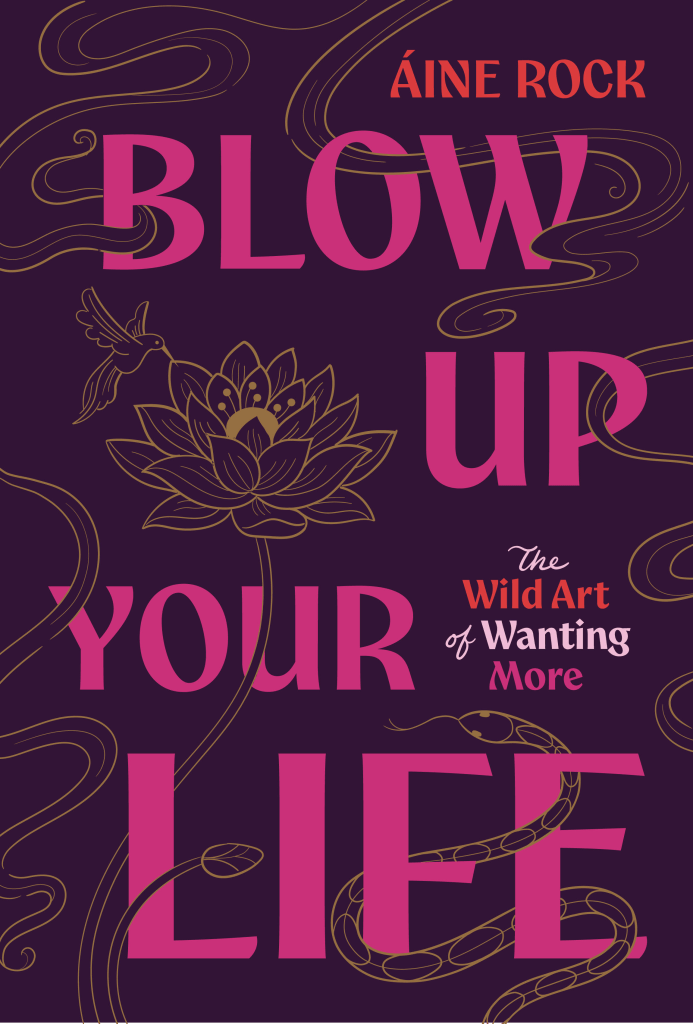
The title of my book is Blow Up Your Life. But that’s not really the point of it.
The point is the coming home.
Maybe it’s midlife, maybe it’s hormones, maybe it was sobriety or microdosing — but I blew up my life to find my way back to the woman I always wanted to be. I’m on the other side of it now. Dancing alone in my kitchen in my lace panties, throwing a party for an audience of none, and happier than I’ve been in a decade. That’s not the ending I planned. It’s better. And I can tell you from here — it is never too late to decide the life you’ve been living was just the first draft.
Áine Rock
Áine Rock is a somatic practitioner, author, and entrepreneur. Her memoir Blow Up Your Life: The Wild Art of Wanting More (Rise Books / Simon & Schuster) publishes July 7, 2026. Her podcast, The Wild Art of Wanting More, launches June 2026. Find her at ainerock.com or @its_aine_rock.
Feel like you need more like this? Check out our other essays on divorce and separation.