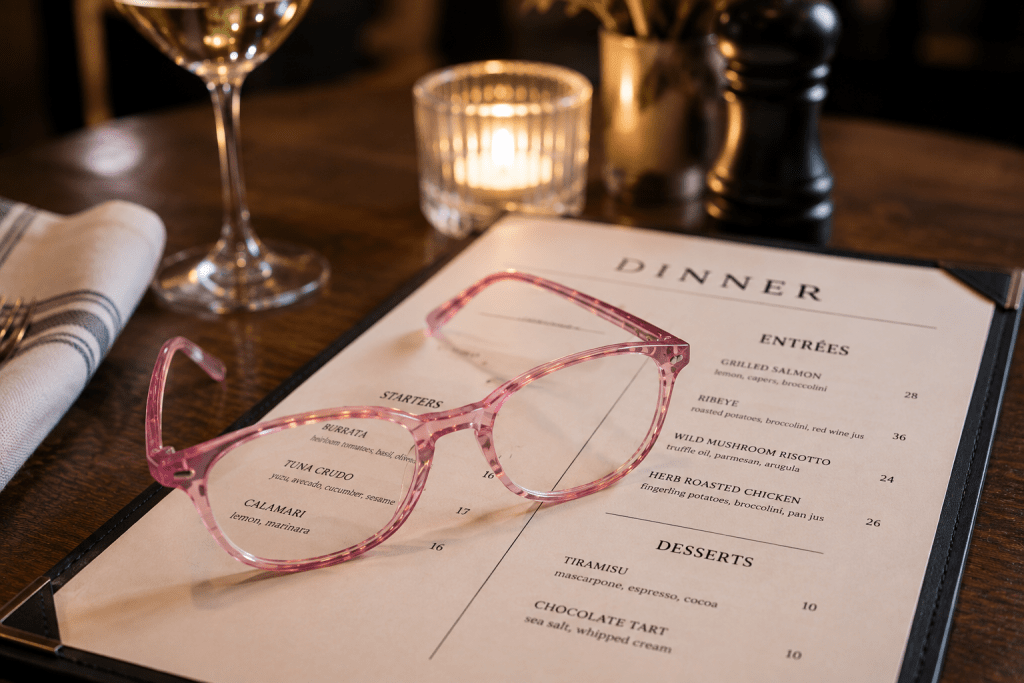
If you’ve recently found yourself holding menus at arm’s length, reaching for reading glasses, or wondering why your eyes suddenly feel dry, tired, or irritated, you’re not imagining it. Just like your skin, joints, and hormones, your eyes go through significant changes during perimenopause and menopause—and many women have no idea what’s happening.
The good news? You don’t have to accept blurry vision, burning eyes, or constant irritation as “just getting older.” We sat down with Dr. Elvia Canseco to find out what’s really happening behind the scenes, which symptoms deserve attention, and why your annual eye exam may be one of the most important health appointments you make in midlife.
Many women expect their vision to change in their 40s and 50s, such as suddenly needing reading glasses. Beyond just visual acuity, what are the most common physical changes happening to the eyes during this stage of life?
Most women expect to need reading glasses at some point, but that’s really just one piece of the story.
One of the most common age-related changes is presbyopia, which is the natural loss of the eye’s ability to focus up close. It’s a normal part of aging and can usually be corrected easily with reading glasses, contact lenses, or other vision correction options.
During our 40s and 50s, we also begin to see changes in the ocular surface. Tear production decreases, the oils that help keep our tears from evaporating become less effective, and many women notice burning, fluctuating vision, irritation, or tired eyes by the end of the day. The good news is that many of these ocular surface conditions are treatable, and with the right diagnosis, women can often find significant relief and continue enjoying the activities they love.
This is also the time when age-related conditions like cataracts and glaucoma become more common. Many of these conditions are highly manageable when caught early, which is why routine comprehensive eye exams become increasingly important during this stage of life.
We often hear about hot flashes and skin changes during perimenopause and menopause, but how do these significant hormonal shifts specifically impact eye health?
Hormones affect much more than people realize—including our eyes.
Estrogen and androgen receptors are found throughout the eye, so when hormone levels fluctuate during perimenopause and menopause, many women begin to notice symptoms like dryness, irritation, fluctuating vision, or increased sensitivity to light.
Hormonal changes can also make underlying conditions more noticeable. I often see women who assume their itchy, irritated eyelids are simply part of aging or menopause, when in reality they have blepharitis, meibomian gland dysfunction, or even Demodex blepharitis. These conditions are incredibly common, can often exist together, and the good news is they’re very treatable once they’re properly diagnosed.
Why does dry eye become so much more prevalent now, and what specific symptoms should women stop brushing off as just normal aging?
Dry eye becomes much more common during this stage of life because both tear production and tear quality change.
The symptoms aren’t always obvious either. It’s not just “dryness.” Women may notice burning, watering, fluctuating vision, redness, contact lens intolerance, eye fatigue while reading or working on the computer, or the feeling that something is constantly in the eye.
One thing I always tell patients is that just because something is common doesn’t mean it’s normal or that you have to live with it. Today we have many more treatment options than we did even a few years ago, and addressing dry eye early can make a tremendous difference in comfort and quality of life.
Many adults skip their annual eye exam if their vision seems fine. Why is it absolutely critical for women in their 40s and 50s to see an eye doctor regularly, even if they have 20/20 vision?
Having 20/20 vision doesn’t necessarily mean your eyes are healthy.
Many eye diseases—including glaucoma—can develop silently for years before patients notice any changes. During a comprehensive eye exam, we’re evaluating much more than how well you read the eye chart. We’re assessing the health of the retina, optic nerve, lens, ocular surface, and eyelids.
I’ve diagnosed serious eye conditions in patients who came in saying, “I see just fine.” That’s why regular exams become even more valuable in midlife—they allow us to detect problems before they begin affecting vision.
When a midlife woman comes in for a comprehensive exam, what are some of the lesser-known—yet highly common—underlying eye conditions you are specifically screening for?
We’re looking for much more than a new glasses prescription.
Of course we’re screening for cataracts, glaucoma, and macular degeneration, but I’m also paying close attention to the ocular surface. Dry eye disease, meibomian gland dysfunction, blepharitis, and Demodex blepharitis are all incredibly common, especially in women during and after menopause.
An eye exam can also provide important clues about overall health. Sometimes we’re among the first to detect signs of diabetes, hypertension, or other systemic conditions because we’re able to directly examine the blood vessels and nerves inside the eye.
One underdiagnosed condition that frequently causes red, itchy eyes and “crusties” on the eyelids is Demodex blepharitis (DB). Can you explain exactly what this is and how to treat it?
Demodex blepharitis is much more common than most people realize.
Demodex mites naturally live on our skin, but when they overpopulate around the eyelashes, they can cause chronic inflammation of the eyelids. Patients often describe itching, redness, irritation, burning, or debris at the base of the lashes that seems to keep coming back despite using artificial tears or over-the-counter products.
The diagnosis is actually straightforward during a routine eye exam because we can identify the characteristic collarettes around the eyelashes. Today, we also have the first FDA-approved treatment for Demodex blepharitis, a prescription eye drop that’s used twice a day for six weeks. For many patients who’ve been dealing with these symptoms for years, the difference can be remarkable. I often tell patients they don’t realize how uncomfortable their eyes had become until they finally experience relief.
If a woman reading this has been experiencing eye irritation or hasn’t seen an eye doctor in a few years, what questions should they be asking their eye doctor once they finally get in the exam room?
I would encourage women to ask, “What’s actually causing my symptoms?” instead of assuming it’s simply part of getting older.
Ask whether your symptoms could be related to dry eye, eyelid disease, allergies, or another underlying condition. Ask what treatment options are available—not just how to temporarily relieve the symptoms.
And even if your eyes feel perfectly fine, ask whether everything looks healthy. Some of the most important eye diseases don’t cause symptoms until they’ve already progressed. A comprehensive eye exam isn’t just about seeing well today—it’s about protecting your vision for years to come.
Dr. Elvia Canseco
Dr. Elvia Canseco is a board-certified, fellowship-trained ophthalmologist specializing in advanced cataract and refractive surgery, complex anterior segment procedures and minimally invasive glaucoma surgery. She combines precision, the latest ophthalmic technology and a patient-centered approach to deliver outstanding outcomes.
Born in Mexico City and raised in Chiapas, Dr. Canseco graduated cum laude from Rice University, earned her MD from UTMB Galveston, and completed residency at UT Houston. She then pursued a prestigious fellowship in Cornea, Refractive and Anterior Segment Surgery at Tufts University and Ophthalmic Consultants of Boston.
Her career spans clinical excellence, teaching, and community outreach:
She has trained NASA astronauts on eye emergencies in space, taught ER physicians how to handle eye trauma, and appeared on Univision and Telemundo to share eye health education with the public.
Dr. Canseco is a fellow of the American Academy of Ophthalmology and the American Society of Cataract and Refractive Surgery, and an active member of Women in Ophthalmology and the American Medical Women’s Association. Locally, she participates in the Houston Ophthalmological Society and Texas Ophthalmological Association.
She has been recognized with multiple honors, including Houstonia Magazine Top Doctor, Super Doctors Rising Star, Castle Connolly Top Doctor, as well as the Vitals Patient’s Choice and U.S. News & World Report Patient’s Top Choice Awards.
Dry eyes are just one of the many surprising changes that can happen during perimenopause and menopause. For more expert advice and real-life stories, visit our Menopause Library.